
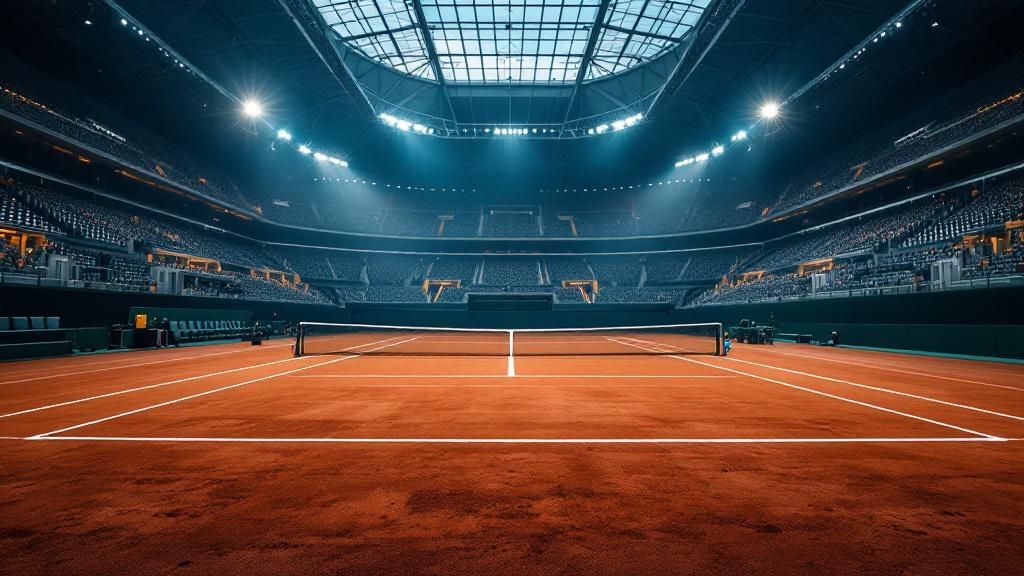
Real Madrid’s iconic Bernabeu stadium will accommodate a training court for the world’s top-tier tennis players in advance of the Madrid Open in the coming month. The esteemed stadium will briefly exchange grass for clay during 23-26 April, offering top-ranked competitors such as Spanish world number one Carlos Alcaraz an chance to perfect their training for one of professional tennis’s biggest tournaments outside the Grand Slams. The practice activities, which will mirror the clay surfaces utilised at the tournament’s central venue, the Caja Magica, will remain open to the public. The Madrid Open, which spans 20 April through 3 May, features both the ATP and WTA tours, making it one of the sport’s leading combined events.
A venue converted for the sport of tennis
The decision to utilise the Bernabeu represents an forward-thinking solution to a growing operational difficulty confronting the Madrid Open. The tournament’s growth to 96-player singles draws contested across a fortnight, alongside the addition of doubles events, has stretched the capacity of the Caja Magica past its workable constraints. By gaining entry to one of world football’s most recognisable stadiums, organisers have found a way to accommodate the tournament’s ambitious growth whilst maintaining the quality of training amenities available to the world’s top players.
Tournament director Feliciano Lopez stressed that the move serves a legitimate athletic objective rather than simply operating as a marketing exercise. “The goal is to have a dedicated practice surface which helps them – it’s not just a commercial opportunity,” the three-time Wimbledon quarter-finalist said to BBC Sport. Lopez stressed that following the announcement of the deal, he has been approached from players and coaching teams wanting to access the facility. Real Madrid do not have any home matches planned during the week when their newly renovated stadium will be adapted for tennis.
- Training opportunities available to elite players during 23-26 April
- Court surfaces will precisely mirror the Caja Magica clay
- Public access to practice sessions will not be permitted
- Tournament matches will remain solely at Caja Magica venue
Why Madrid Open needed additional facilities
The Madrid Open has gone through a considerable transformation in the past few years, transitioning from a conventional event into one of professional tennis’s most ambitious and innovative events. The increase to 96-player singles draws contested over a two-week period, paired with the inclusion of full doubles programming, has produced unprecedented demand on existing infrastructure. Tournament administrators found themselves facing a genuine capacity crisis at their established base, the Caja Magica, which could not accommodate the expanded draw whilst upholding the rigorous standards expected by the top-ranked players and their coaching teams.
This expansion demonstrates the tournament’s growing prestige and financial attraction within the professional tennis calendar. As one of the major competitions outside the Grand Slam events, the Madrid Open attracts the sport’s top players and generates considerable worldwide engagement. However, this accomplishment led to a paradox: the very popularity that made the tournament so valuable also strained its physical resources. Tournament director Feliciano Lopez understood that creative approaches were vital to maintain the event’s trajectory and continue attracting top-tier participation from both ATP and WTA tours.
Outgrowing the first space
The Caja Magica, located approximately five miles to the south of central Madrid, has been the Madrid Open’s venue for a considerable period. However, the venue’s shortcomings grew more evident as the tournament expanded its scope and ambition. The facility, whilst sufficient for the tournament’s traditional format, found it difficult to offer adequate training courts and coaching facilities for the substantially expanded player base now taking part in the event. This restriction threatened to compromise the quality of preparation provided for competitors.
By obtaining use of the Bernabeu, organisers have successfully addressed this operational challenge whilst simultaneously generating considerable commercial advantage. The celebrated football venue’s transformation into a tennis facility demonstrates innovative solution-finding at the top management echelon. The setup enables the tournament to maintain its sporting credibility and competitor fulfilment whilst maintaining its expansive expansion path, ensuring the tournament continues as one of professional tennis’s most coveted and comprehensively supported competitions.
Real Madrid’s athletic aspirations grow
Real Madrid’s choice to establish a practice court at the Bernabeu constitutes a strategic expansion of the club’s athletic interests past traditional football. The 15-time European Cup winners have displayed their commitment to adopting innovative partnerships that boost their iconic stadium’s global profile. By welcoming the world’s top tennis competitors to one of sport’s most recognisable venues, Real Madrid has established itself as a progressive institution able to deliver world-class events across various sports. This move fits with the club’s broader vision of the Bernabeu as a versatile sports venue, following its newly finished refurbishment that transformed it into a state-of-the-art facility.
The structure carries limited interference to Real Madrid’s competitive schedule, as the club has strategically timed the court construction to prevent key league matches. Should Real Madrid progress through the Champions League quarter-finals in their Bayern Munich tie, any subsequent matches with Liverpool or Paris St-Germain would be contested away during the relevant period. This careful coordination ensures the club’s competitive interests stay protected whilst continuing to exploit the commercial and promotional opportunities offered through staging one of tennis’s leading events. The partnership illustrates the way modern sports organisations can leverage their facilities and established reputation to strengthen their position within the broader sports ecosystem.
| Feature | Details |
|---|---|
| Practice court dates | 23–26 April 2026 |
| Tournament dates | 20 April – 3 May 2026 |
| Court surface | Clay, matching Caja Magica specifications |
| Public access | Not open to spectators |
Tournament director Feliciano Lopez has been emphatic that this arrangement represents a authentic athletic programme rather than a superficial marketing exercise. The former world number 13 has received considerable interest from athletes and training personnel keen to utilise the Bernabeu’s training grounds during their competitive build-up. Lopez’s vision focuses on concrete value for athletes, confirming the partnership upholds the tournament’s competitive integrity and competitor welfare above all other factors.
Marketing innovation meets real-world application
The Madrid Open has firmly positioned itself as a competition willing to push boundaries and challenge convention within the professional game. From unveiling an striking blue clay surface to using fashion models as ball kids, the event has continually aimed to capture worldwide interest through imaginative initiatives. Director Feliciano Lopez has stressed that the event prides itself on innovative approaches and taking calculated risks to provide fresh opportunities for players and spectators alike. This recent project at the Bernabeu represents the natural evolution of that approach, blending the legendary stadium’s worldwide recognition with authentic performance advantages.
Beneath the prestigious surface of hosting matches at one of world football’s most prestigious venues lies a genuine requirement driving the decision. The Madrid Open’s expansion to 96-competitor singles draws contested over a two-week period, alongside comprehensive doubles competitions, has rapidly outgrown the Caja Magica’s capacity. By utilising the Bernabeu’s expansive facilities for player preparation, organisers address genuine logistical constraints whilst simultaneously generating substantial marketing value. This dual approach ensures the partnership delivers tangible advantages to competitors rather than functioning purely as a marketing spectacle removed from sporting reality.
- Blue clay surface implemented to improve the visual presentation and broadcast quality
- Fashion models utilised as ball kids throughout recent tournament editions
- Virtual tournament held during 2020 coronavirus pandemic via gaming consoles
- Tournament expansion demands supplementary facilities exceeding Caja Magica capacity
- Practice court installation addresses player training requirements authentically
Exploring prospects for tennis at the Bernabeu
Whilst the present arrangement is limited to practice facilities, the positive outcome of this opening partnership could potentially reshape how the Madrid Open runs in the years ahead. Tournament director Lopez has been keen to temper expectations, noting that hosting competitive fixtures at the Bernabeu remains outside the organisation’s immediate plans. However, the benchmark created by other significant tournaments must not be completely overlooked. The Miami Open’s integration of a showcase court within the Hard Rock Stadium illustrates that such configurations are feasible at elite sporting venues, should conditions and logistics work out positively in future editions.
For now, the focus remains firmly on providing tangible benefits to the global top athletes during the crucial preparatory period before the primary competition begins at the Caja Magica. The access of a world-class practice venue at one of international sport’s most prestigious stadiums provides an unprecedented chance for competitors to refine their clay-surface techniques. Whether this proves a standalone showcase or the foundation for a ongoing collaboration will ultimately depend on how effectively the initiative serves player needs whilst preserving the tournament’s reputation for innovation and quality.
